1. Introduction: The World on the Edge
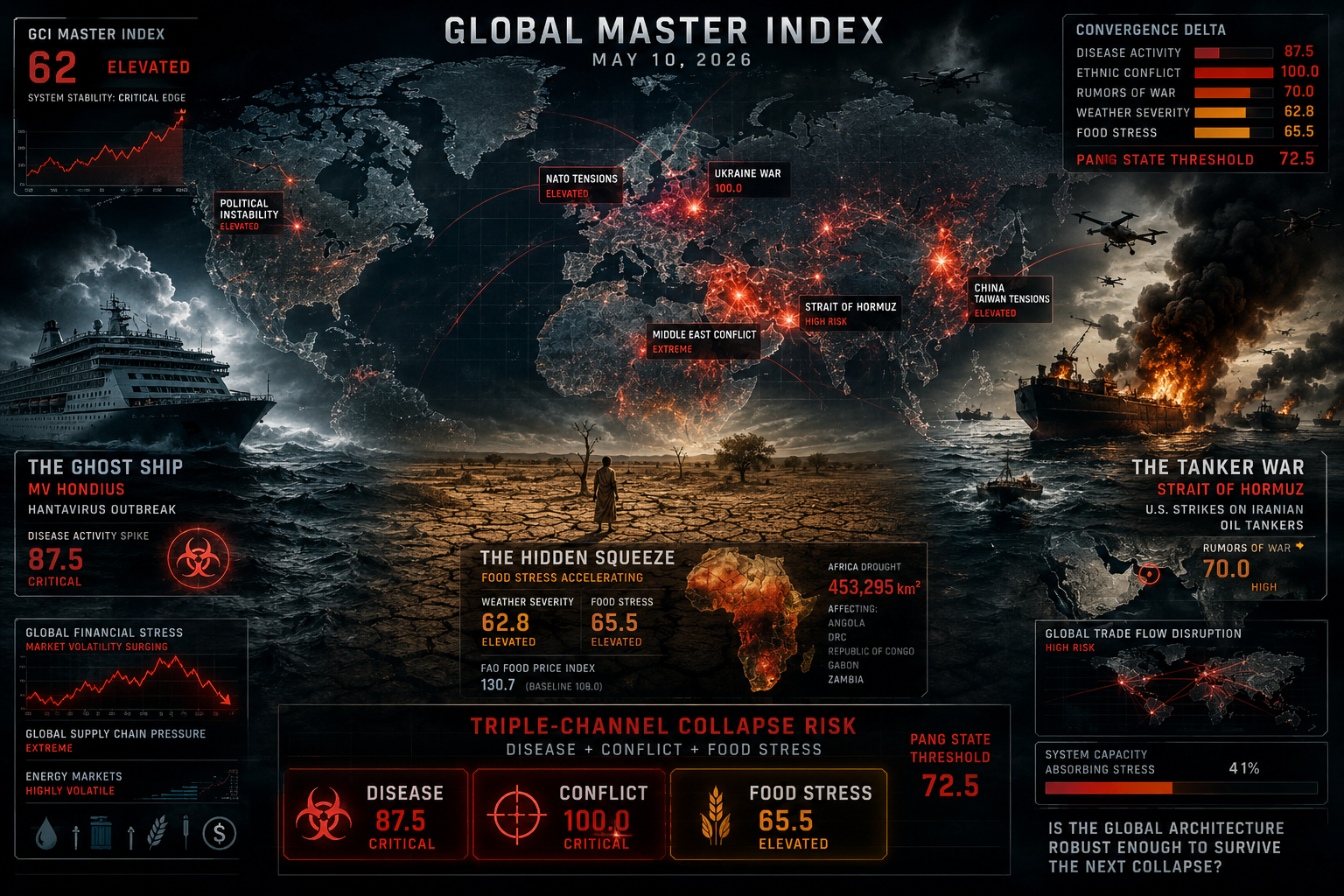
As of May 10, 2026, the Global Crisis Intelligence Master Index sits at 62, a figure that describes a global system operating at the extreme edge of its tolerance. This is not a static measurement; it is a high-frequency vibration occurring just before a structural failure. While the “Elevated” status suggests we are not yet in total freefall, the underlying data reveals a world navigating a razor-thin corridor. We are witnessing the synchronization of disparate crises—biological, kinetic, and environmental—each feeding into a narrative of systemic fragility that our current global architecture was never designed to absorb.
2. The Ghost Ship: Hantavirus at Sea
The MV Hondius, currently idling off the coast of Tenerife, has become a visceral symbol of modern vulnerability. The vessel is the epicenter of a Critical disease activity spike, with the sector score surging to 87.5. The hantavirus outbreak on this confined cruise ship illustrates the terrifying speed at which localized biological threats can paralyze international maritime commerce and overwhelm regional response capabilities.
The evacuation efforts by Spanish health officials are a logistical nightmare, highlighting the “Pang State” reality of our current health security. This event is not merely a medical crisis; it is a demonstration of how a single isolated vector can trigger a “Critical” status in an era of hyper-mobility.
“A medical epidemiologist explains what to know about the cruise ship hantavirus outbreak as Spanish health officials board the vessel to begin the high-risk evacuation of passengers.”
3. Restraint is Over: The Iran-US Tanker War
The Middle East has abandoned the “fragile ceasefire” for a state of active, high-stakes confrontation. The “Rumors of War” metric has solidified at 70.0, catalyzed by U.S. military strikes on Iranian oil tankers in the Strait of Hormuz. A definitive turning point in this escalation was the destruction of the Indian S-400 system. This event is strategically seismic: it suggests either a failure of high-tier third-party defense systems or a widening of the conflict that now draws in major non-aligned powers, complicating the theater beyond traditional US-Iran binaries.
As the U.S. continues to fire upon and disable Iranian assets, Tehran has moved from diplomatic posturing to a doctrine of direct retaliation.
“Iran Declares Restraint Is Over.”
This declaration signifies that maritime energy corridors are no longer “friction zones” but active battlefields, threatening the very arteries of global trade.
4. A Counter-Intuitive Claim: Is Ukraine Finishing?
In a move that defies the ground-truth data, Vladimir Putin has publicly suggested the Ukraine conflict is “coming to an end.” This claim must be weighed against the reality that Ethnic Conflict remains at a maximum score of 100.0. The strategic narrative shift from the Kremlin is likely a reaction to the “low-key” Victory Day celebrations on May 9, which exposed a depletion of both logistical capacity and domestic political momentum.
Rather than a signal of genuine de-escalation, this narrative appears to be a calculated pause. When a system is at a 100.0 conflict saturation, a “peace” claim is often just a maneuver to reset the front lines before the next surge.
5. The Hidden Squeeze: When Weather Meets the Plate
While the headlines focus on tankers and viruses, a “Convergence Delta” is forming between Weather Severity (62.8) and Food Stress (65.5). The Weather Severity score has seen a rapid acceleration (Δ ▲ +11.8), driven by 328 active NOAA alerts and a massive agricultural drought. This is “dual-vector stress”: atmospheric shocks are no longer isolated events; they are directly compressing agricultural output and driving the FAO Food Price Index to 130.7, far above the 108.0 baseline.
The impact is most acute in Africa, where a massive drought is devastating 453,295 km² of land across Angola, the Democratic Republic of Congo (DRC), the Republic of Congo, Gabon, and Zambia. This squeeze is more dangerous than a localized war because it attacks the foundational stability of the global south, creating a vacuum that inevitably leads to further civil unrest.
6. Conclusion: The Convergence Threshold
The Master Index of 62 is a deceptive average. In reality, we are already in a Dual-Vector Pang State, with both Ethnic Conflict (100.0) and Disease (87.5) exceeding the 72.5 “Pang State” threshold—the point where a category enters total, unmanageable volatility.
We have not yet hit the catastrophic “3-channel simultaneous Pang State,” but with Food Stress and Rumors of War both trending toward the 72.5 mark, the threshold is within sight. The global system is currently absorbing these intersecting stresses, but its capacity to do so is finite. We must ask: Is the current global architecture robust enough to survive the next channel’s collapse, or is a total systemic Convergence now inevitable?