Executive Summary
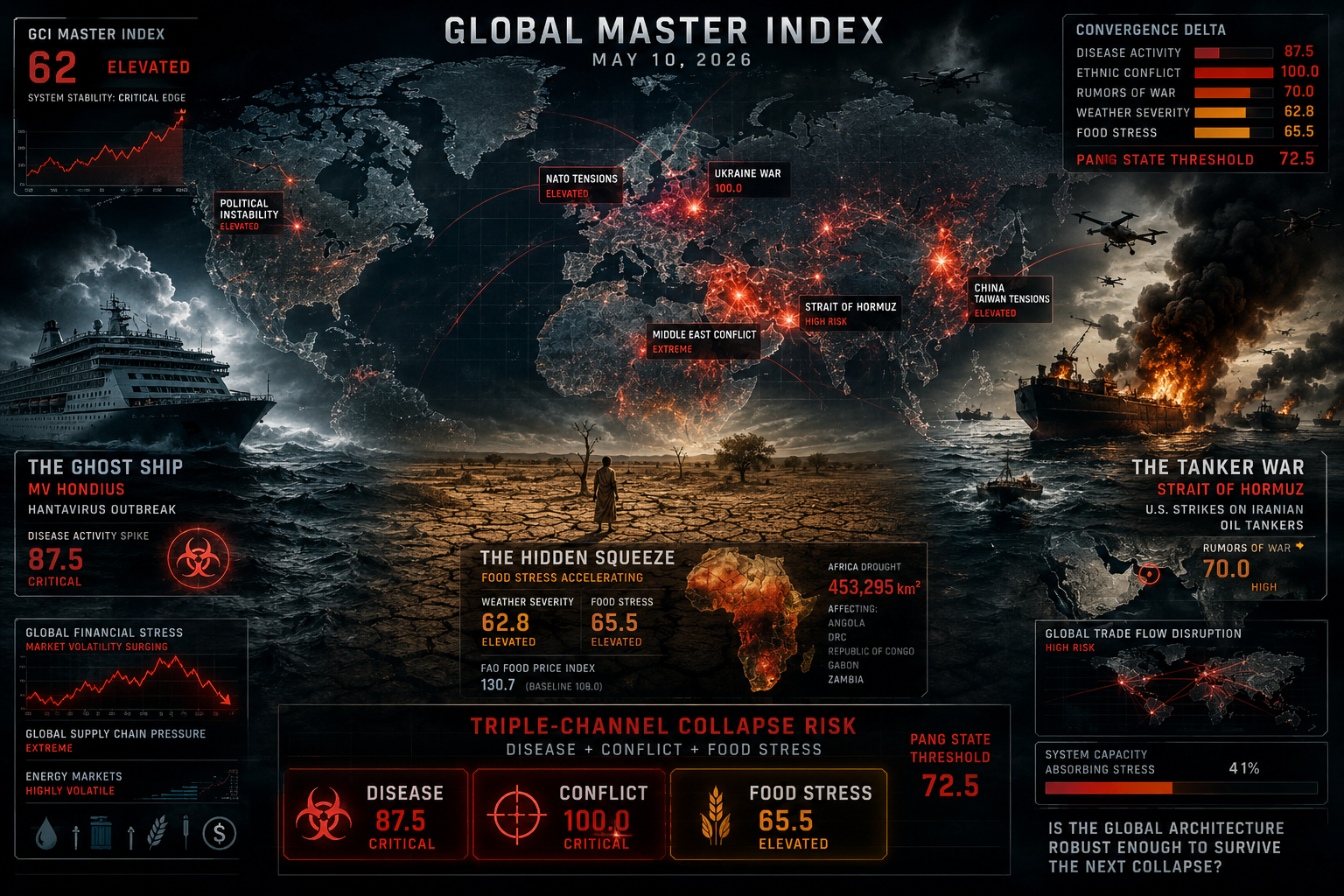
As of May 10, 2026, the Global Crisis Master Index stands at 62, indicating an Elevated state of global stress. While the index remains below the threshold for active systemic convergence, several sectors—most notably Disease Activity and Ethnic Conflict—are experiencing significant volatility.
The most critical development is a Hantavirus outbreak aboard the vessel MV Hondius off the coast of Tenerife, which has pushed Disease Activity into a “Critical” status (87.5). Simultaneously, geopolitical tensions in the Middle East have intensified following the disabling of Iranian tankers by U.S. forces and Iran’s subsequent declaration that its period of “restraint is over.” While there are conflicting reports regarding the trajectory of the Ukraine conflict, the primary drivers of global instability remain Ethnic Conflict (100.0), Disease (87.5), and Rumors of War (70.0).
——————————————————————————–
Crisis Indicator Dashboard
| Category | Score | Status | Trend (Δ) |
|---|---|---|---|
| Disease Activity | 87.5 | CRITICAL | Unchanged |
| Food Stress | 65.5 | ELEVATED | Unchanged |
| Weather Severity | 62.8 | ELEVATED | +11.8 |
| War & Conflict | 50.0 | Monitoring | Unchanged |
| Seismic Activity | 49.3 | Monitoring | +7.3 |
| Civil Unrest | 48.0 | Monitoring | Unchanged |
| Economic Stress | 45.9 | Monitoring | Unchanged |
| Humanitarian Impact | 40.2 | Monitoring | Unchanged |
——————————————————————————–
Primary Drivers of Global Instability
1. Critical Health Emergency: Hantavirus Outbreak
Disease activity has reached a critical threshold, primarily driven by a localized but severe outbreak on the MV Hondius.
- Vessel Isolation: The ship is currently positioned off the Port of Granadilla on the Spanish island of Tenerife.
- Emergency Response: Spanish health officials have boarded the vessel to begin the evacuation of passengers.
- Pathogen Context: Medical epidemiologists are providing briefings to manage public concern regarding the hantavirus, which has necessitated a full-scale health emergency response off the Tenerife coast.
2. War and Geopolitical Conflict
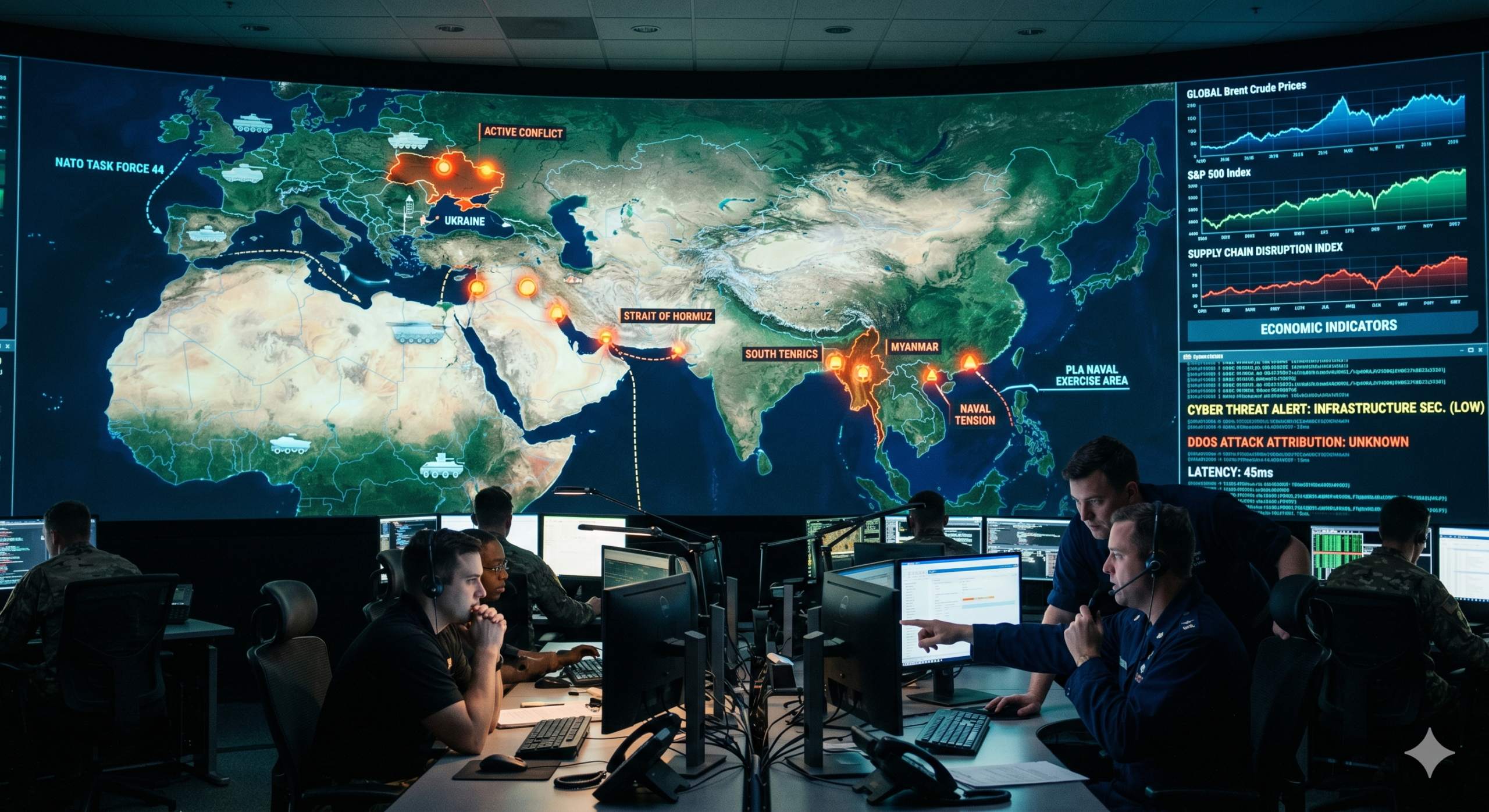
The geopolitical landscape is dominated by heightening tensions in the Middle East and shifting narratives in Eastern Europe.
- Iran and the Middle East:
- Tanker Disabling: U.S. forces have fired on and disabled at least two Iranian tankers in the Strait of Hormuz.
- Diplomatic Escalation: Iran has officially declared that “restraint is over,” accusing the United States of “reckless military adventure.”
- Lebanon Strikes: Israeli drone and air strikes near Beirut and in southern regions have resulted in at least 17 fatalities.
- Fragile Ceasefire: While a ceasefire currently appears to hold, Iran has issued stern warnings against further attacks on its oil tankers and shipping interests.
- Ukraine/Russia Relations:
- Conflicting Signals: President Putin has publicly stated his belief that the Ukraine conflict is “coming to an end.”
- Victory Day: Observers noted that Russia’s Victory Day celebrations were uncharacteristically “low-key,” potentially signaling a shift in domestic or military strategy.
- South Asia: The destruction of an Indian S-400 system has been identified as a major turning point in regional stability.
3. Food and Environmental Stress
Environmental factors are beginning to exert pressure on global supply chains and agricultural outputs.
- Food Pricing: The FAO Food Price Index has reached 130.7, significantly higher than the baseline of 108.0 (2014-16=100).
- Weather Extremes: NOAA has issued 328 active alerts in the United States, including 74 classified as “Severe.” Notable events include severe thunderstorm warnings in Texas and special marine warnings in Florida.
- Agricultural Impact: There is an observed intersection between weather severity and food stress, as atmospheric events begin to compress agricultural output.
4. Seismic and Humanitarian Indicators
- Seismic Activity: Global seismic activity is currently at a monitoring level (49.3), with 13 M4.5+ events recorded by the USGS in the last 24 hours, consistent with historical baselines.
- Humanitarian Concerns: GDACS is monitoring 66 active events. “Orange” alerts are currently active for:
- Volcanic Activity: Indonesia.
- Drought: A medium-impact agricultural drought is affecting 453,295 km² across Angola, the Democratic Republic of Congo, Republic of Congo, Gabon, and Zambia.
——————————————————————————–
Convergence Analysis: Systemic Risk Assessment
The Convergence Delta indicates that while the Master Index (62) is elevated, the world has not yet reached the “Active Convergence” threshold, which requires three or more categories to simultaneously enter a “Pang State” (score ≥72.5).
- Dual-Vector Stress: Currently, only Ethnic Conflict and Disease are in a Pang State. This indicates a concentrated dual-vector stress.
- Channel Intersection: A critical point of concern is the intersection of Weather Severity and Food Stress. Atmospheric events are actively diminishing agricultural output, which may lead to further price spikes in the FAO index.
- Concentrated Activity: At present, verified crisis headlines remain concentrated in specific categories rather than being broadly distributed across all sectors, suggesting that while the risks are high, they have not yet synchronized into a total systemic collapse.